
Product-ive roadmapping for the holiday slowdown
As we head into the end-of-year home stretch and the inevitably slower holiday period, I decided to make some roadmap adjustments to ensure we would finish the year strong.
The Product Decision: Line up a collection of smaller stories, projects, and research to advance roadmap initiatives and to keep the teams productive.

Flickr image source: http://tinyurl.com/q6koct4
As we head into the end-of-year home stretch and the inevitably slower holiday period, I decided to make some roadmap adjustments to ensure we would finish the year strong.
It is difficult for any team to plan well for last few weeks of the year. Even if your business doesn't align with the traditional calendar year, you are likely to be working with customers, partners, and vendors who do scramble to wrap up their quarters and annual cycles at year's end.
On top of that, many of your employees are requesting time off from work leaving sizable gaps in the schedule. And you can just give up on trying to arrange any real business-related travel plans, e.g. to visit customers or to conduct on-site interviews.
With all the distractions that come with the holiday period, I began to ask myself how I could make the most of these remaining weeks of the year.
What drove this decision
We had been moving at a nice clip for the past few months. I was proud of the work being cranked out by the Product and Tech teams. We had achieved some good momentum and I was eager to preserve as much of that as I could. Many of the current projects would naturally extend into the early part of next year and I was determined to minimize any slow down around these particular initiatives.
We had achieved some good momentum and I was eager to preserve as much of that as I could.
But I also knew that it would be difficult for teams to coordinate larger tasks if their coworkers' schedules were inconsistent. With all that in mind, I took another look at the product roadmap to optimize our efforts for the last few sprints of the year.
The decision: Line up a collection of smaller stories, projects, and research to advance roadmap initiatives and to keep the teams productive.
I don't want to make it sound like the teams would otherwise be idle. We had just deployed our last major release of the year and I knew we would have some post-release work to tackle. For example, it was going to take some team coordination to gradually and prudently roll out some of the latest enhancements to the full customer base. Then there was the need to respond to users who would be wrestling with the most recent product changes. And of course, we are always prepared to deal with any bugs that may have slipped through.
The real challenge for me was to identify new product work that we could take on and to fit it into our irregular schedule.
Plan of attack
My goal was to maximize the collective team utilization and minimize any dead spots in the upcoming calendar. No one would be satisfied with blatant busy work and yet, it would be difficult to make much tangible progress on any new product initiative. I, more than anyone, wanted to feel like we had been productive during this time.
I determined that no one solution was going to work so to increase my chances of success, I ended up using several different approaches simultaneously. In the end, I was able to surface a number of smaller-scale projects to accommodate the various gaps in the teams' schedules.
Lay the remaining groundwork for next year's new product offering
Over the last 8-10 months, we had been working on a number of smaller, separate initiatives that were intended to fit together to create a larger, cohesive feature set. However, unless you had been working closely with the Product team, it would be difficult to see how the individual building blocks we had been delivering over many releases were meant to come together. This was the time to explain the broader vision.
I began by updating the product roadmap to illustrate how we would piece together 4 or 5 of the individual initiatives to create a major new offering to be rolled out in the early part of next year. Then, I scheduled new stories that would ultimately combine the separate components into a new whole. I had already convinced myself that this was going to be a thing of beauty but of course, I have been wrong before!
After we had finished connecting the dots (and bytes) and had painted the whole picture, we would be able to move forward by putting it in front of our users. I would continue to validate the new offering by testing it with our internal stakeholders, with customers in our Labs program and finally with prospects in the Sales funnel.
Tee up a list of discretionary items to fill downtime
Without even looking closely at the calendar, I knew we would have a week or so before the start of January where the Engineering ranks would be somewhat thin. My counterpart overseeing Engineering agreed that we could declare a "free sprint" where the developers would have more latitude in how they spent their time in the office.
I had a decent backlog of research topics that I lined up in case the well of ideas ran dry but I was pretty sure the developers would surface their own pet projects to keep themselves occupied. We continue to see some forward-thinking proposals come up through Engineering and I certainly wanted to encourage more of that activity.
I was pretty sure the developers would surface their own pet projects to keep themselves occupied.
There were, in fact, a few out-of-band product initiatives that were already in motion, and all in different stages of completeness. Those Tech Team members that had expressed an interest in exploring extracurricular material had been encouraged to do so with the intention of tying the work back to short- and/or long-term customer value. Based on the success of those efforts, I could easily extend the initiatives and even stage a few more to follow.
Swap in some overdue projects to tackle technical debt
The company has had a banner year in terms of acquiring new customers. But the reality of growing your customer base and increasing the number of users/transactions on your platform is that scale-related challenges bubble to the top. Inevitably, I would need to schedule some cycles for the less glamorous housekeeping activities.
Every software company has technical debt and it requires discipline to stay on top of that debt. I am always grateful to find those few Engineers that appreciate the value of cleaning up and are quick to roll up their sleeves (can you roll up t-shirts sleeves?) and pitch in to help. We would use this end of the year time to tackle a few of these efforts as well.
The impact
It can be tricky for a Product Manager to figure out how to best utilize the weeks at the end of the calendar year. I looked for some small, but important projects that would move us forward but that had few, if any dependencies to avoid schedule impediments.
In using these three approaches: the free sprint, more "groundwork" stories needed to assemble the next product offering, and addressing technical debt, I was able to stock the upcoming sprints with productive work and reduce everyone's concerns about holiday dead time.
Look for more reports from theProductPath around capacity planning, roadmap planning, and managing product teams here on PM Decisions.
More articles from our blog PM Decisions


Initiate a few modest R&D projects
After getting our major roadmap items underway and finding our rhythm with smaller bugs and enhancement requests, I decided it was time to launch a series of background research tasks.
The Product Decision: Recruit uniquely qualified resources to kick off independent, well-scoped initiatives with a high potential to excite both customers and stakeholders.

Flickr image source: http://tinyurl.com/p4s27js
After getting our major roadmap items underway and finding our rhythm with smaller bugs and enhancement requests, I decided it was time to launch a series of background research tasks.
I don’t want to give the impression that we have tons of spare bandwidth. We are struggling with the same resource constraints that plague most Product teams but I believe there is value in prudent technical experimentation. In my experience, even the most ambitious Product Roadmaps are primarily designed to keep everyone going down the same path and they don’t afford much room for concurrent product exploration - and I’m not talking about unexpected wrong turns!
Sometimes you need to launch a few parallel pursuits to introduce new ideas and shake things up.
What drove this decision
I continue to be impressed with our entire technical team and am convinced that there is even more potential there that we can tap into through targeted endeavors. In this case, the team had been making favorable progress on several, in-motion product initiatives and that prompted me to think a little further out than I had been.
Several months back, we had embarked on a plan to upgrade some of the underlying technology in our core platform, partly on the promise that it would deliver advanced functionality above and beyond the legacy components it was replacing. We were now closing in on a major delivery milestone and had a sound plan for the upcoming transition. That inspired confidence and afforded me with some breathing room to further explore the features of this new technology.
Sometimes you need to launch a few parallel pursuits to introduce new ideas and shake things up.
Separately, in another work stream, we had been investing a great deal of resources into building a new data repository to capture information related to the user activity in every automated business process. The initial payoff would be the launch of a new mobile application which gives users unprecedented visibility into their own workflows.
The mobile app was now being rolled out to customers but that initial investment was always intended to yield more for us and for our users. This seemed like a good time to start work on the next phase of that product initiative.
The decision: Recruit uniquely qualified resources to kick off independent, well-scoped initiatives with a high potential to excite both customers and stakeholders.
R&D efforts are not always guaranteed to deliver positive or even actionable results. Still, I didn’t want my first ventures to fall flat as I intended to follow up with additional waves of experimentation. Ideally, the R&D projects would help to determine which ideas were feasibility and for those, what we should expect in terms of level-of-effort to implement, deliver and support them. This would help me assess how and when to fold them into the Product Roadmap.
I was also planning to share the results with the Management Team and our Board in order to show what we might be capable of delivering at the far end of the Roadmap. A secondary goal for me then was to demonstrate early success and improve the chances of funding future R&D work.
Plan of attack
These initial projects were trial balloons for me and the Product team. If we succeeded in producing positive results, we were likely to be encouraged to continue exploring and experimenting. To increase our chances of success, I took care to limit the scope of each effort, to pick the right team resources, and to schedule shorter term deliverables.
Disclaimer: As R&D projects can be sensitive and can often impact a business' competitive advantage, I have chosen to sanitize and share just 2 of the projects here.
Project A explored the viability of an inverted search feature that enables an end user to determine if a given document matches one or more search terms. Our customers have shared use cases where they need to know if a modified document still contains one or more paragraphs, terms, etc. An inverted search could discern whether a given contract contained one more standard clauses for example.
Project B looked to expand our company’s use of analytics to report on and ultimately improve document workflows. Customers were already investing heavily into our platform’s workflow features to automate their business processes and I wanted to be able to give them much more data to evaluate the people, process, and documents involved in those workflows.
Scope each effort
In my opinion, the most important factor for success was in how we defined the projects. Too broad and we might never see any results. Too small and they may be de-prioritized or even dismissed.
For the first project, I needed to show the general applicability of the inverted search and the relative effort to configure the function. We didn’t need to tackle complicated documents or complex search terms but we did need to stay relevant to our customers’ use cases. The goal for this project was to prove the feasibility of the technology - usability would be addressed in a separate effort.
The other project was quite different. Here I was looking to identify the overlap of actual customer inquiries and available analytic data. The goal of this project was to find as many good matches as possible between what our customer research had surfaced around visibility into workflow processes and the rich analytics we could be generating in the future.
Enlist Internal and External resources

Flickr image source: http://tinyurl.com/p2b248t
To kick off Project A, I cornered one of our Software Architects and bribed him with pastries - a low-cost recruiting tool! He is the resource who was primarily responsible for introducing the new technology to the Tech team and who had been overseeing its implementation during the past few months. I sat down with him and painted the picture of how we could use the advanced features of this technology to address real customer problems that were going unsolved. He understood the benefits and like me, recognized the large payoff of a relatively minor product investment. I had no trouble convincing him of the value of a proof-of-concept and promised to carve out time for him to explore this during the upcoming sprints.
For Project B, I went outside the company to find subject matter expertise. I had been introduced to a woman who specializes in all things data, metrics, analytics, and visualization. I had seen examples of her previous work where, given very little in terms of schemas or actual data, she produced some amazing and insightful dashboards. This was exactly the kind of impact I was looking to make with our own embryonic data store. After explaining what little I had to start with but where I was hoping to go, she presented a reasonable proposal that fit within my time and budget constraints. There were very few dependencies on our own internal resources and indeed most of the Tech team had little knowledge of the project. I did pull in our heads of Engineering and UX to help keep me honest and on track.
Timing the project deliverables
As part of the scoping effort, I created schedules for each project that would produce results in a meaningful timeframe. Our next major product release had already been scheduled to coincide with an upcoming industry event. We already had plans to show off the latest product improvements at the trade show but if some of these R&D projects panned out, we would have even more to entice customers and partners.
The impact
Based on this preparation, I was able to get my R&D projects approved, funded and launched successfully. The early evidence is mostly positive and we seem to be on track to deliver on the goals I set early on. Now I'm engaged in some early internal promotion around a few of the projects and have even started to leak some preliminary results to our CEO and our head of Sales to validate the intended ROI. I'll share more progress updates in the weeks ahead.
Look for more reports from theProductPath around product strategy, roadmap planning, and product investments here on PM Decisions.
More articles from our blog PM Decisions

Clarify win-loss speculation with post-mortem interviews
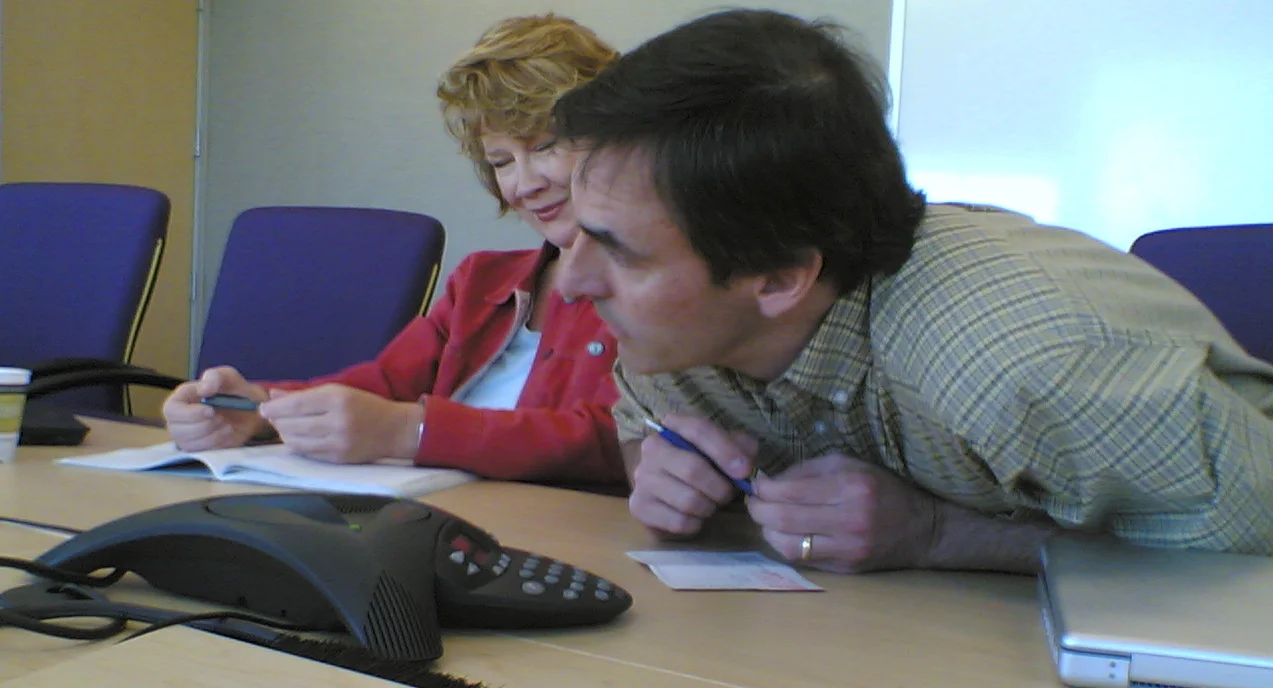
After yet another desperate claim from an exasperated Sales team that we were losing deals because of presumed product gaps, I decided that I needed hear it first hand from the customers.
The Product Decision: Schedule discussions with the lost prospects to learn more about their exact decision criteria.
Flickr image source: http://tinyurl.com/ngyurwt
After yet another desperate claim from an exasperated Sales team that we were losing deals because of presumed product gaps, I decided that I needed hear it first hand from the customers.
I look forward to the days when I can sit with our Sales team on a regular basis (at least quarterly) and formally walk through our wins and losses. I say this somewhat selfishly because I have seen our company overreact repeatedly to lost deals. There is a tendency to find scapegoats and Product is often an easy target.
I know we have sufficient features with clear benefits to close new deals (our win rate is actually pretty high) but it still stings when a customer chooses a competitor. Nobody likes to lose but we need to reflect on these events in a productive way. We need to be truthful with ourselves and learn from our losses.
What drove this decision
A battle was already brewing between Sales and Product around a set of "must-have features" that had been distracting me from the real roadmap priorities.
In fact, I had been cornered a number of times over the past few months, typically by a Sales manager stomping around the office, still sore after getting the bad news that we lost another opportunity.
But warning bells were going off for me after hearing what seemed like unfounded claims that the deal fell apart because our product fell short in a certain area. I was especially curious about one deal in particular which we apparently lost to a couple of vendors with whom we never compete.
Something didn't make sense about these claims and I wanted to reconcile my own hunches with those coming out of Sales.
The decision: Schedule discussions with the lost prospects to learn more about their exact decision criteria.
The Sales team has been winning and losing deals for a long time but aside from our Reps recording one of a dozen pre-defined "reasons" in our CRM, the team had never spent any cycles capturing the details of the sale - and certainly had not been sharing the broader stories in a broader venue.
Our best opportunity to circle back with a lost prospect would have to be soon after they told the bad news. We had 2 such losses in the past 2 weeks and I scrambled with the Sales team to set up separate calls with each prospect to get the rest of the story, from their own mouths.
Plan of attack
Flickr image source: http://tinyurl.com/od5e5na
My suspicion in both cases was that my Sales team had misinterpreted the customer's needs. In both cases, our folks had assumed that it had been a particular feature or set of related features that our competitor offers that had been the deciding factor. I was skeptical, but mostly because I didn't think our Sales team had a complete grasp of the other offering and were being hasty to find a scapegoat.
We scheduled conversations with each prospect and I had the Rep and their Sales manager sit in, mostly to listen. I shared my hypotheses with the Sales folks up front - specifically that I thought we would ultimately get feedback from the customer that was different from the conclusions they had drawn.
I also made it clear to them that I was motivated by a desire to learn and had no intention to lead our witnesses.
Interview 1st prospect about competitor's tool
We had been hearing more and more about one particular competitor product in our sales cycles. They (the competitor) knew we didn't have an answer to it and wisely used their own product as a land mine to trip us up. I don't want to take anything away from our competitor but it was clear that they were intentionally guiding prospects to focus on this tool even when the prospect wasn't struggling with the set of problems it solved.
I've seen the tool and it does provide some attractive features. Until recently, we had been assuming that 1 feature in particular was winning over prospects. But the deal notes from our own Sales Rep on this opportunity pointed to something else.
We learned that our assumptions were wrong - the customer was struggling with a completely different problem.
In a 20-minute conversation with the prospect, we walked through their decision process and ultimately came to the competitor's offering. When prompted to identify the actual pain points and how well the competitor's tool matched up with those pain points, we learned that our assumptions were wrong - the customer was struggling with a completely different problem.
After thanking the prospect, I reviewed the outcome of the call, as gently as I could, with the Sales team to make sure they understood the real criteria of the customer's decision. The new information was indeed valuable and we would have to incorporate the findings into our own product strategy but it was also important to set expectations appropriately inside the company so as not to unnecessarily exaggerate our presumed product gaps.
Interview 2nd prospect about broader needs
The second opportunity was apparently lost to vendors that we never see in our typical sales cycle. That seemed to me to point to a fundamental misunderstanding about what problems that customer is looking to solve.
We ran through a similar post-mortem conversation with this prospect who was all too happy to share their issues again. I find it easy to start conversations with decision makers around their pain and struggles. And even though our Sales team had just spent weeks courting them, they approached this new conversation with our Product team with unexpected enthusiasm.
Our Sales team had clearly wasted way too many cycles chasing an unqualified opportunity AND had drawn unnecessary attention to a presumed product gap.
Since this customer had not yet made a final decision, we steered the discussion to what had separated us from the remaining vendors. What I heard was at the same time validating and frustrating. The customer had legitimate needs but ones that would never be solved by the type of solution we had to offer.
The good news for me was that this lost deal was not going to impact our own ongoing product decisions. The bad news was that our Sales team had clearly wasted way too many cycles chasing an unqualified opportunity AND had drawn unnecessary attention to a presumed product gap.
The impact
Both prospects were not only willing to share with us but actually quite impressed that we would take the time to learn from our lost deals. I would like to think that this customer feedback will only accelerate our plans to formalize our win-loss analysis discussions in the months ahead.
I'm also hopeful that our Sales team will start to acknowledge that they sometimes misread the prospect's ultimate decision and will refrain from rushing to hasty conclusions. Perhaps only time and ultimately, more losses will tell.
Look for more reports from theProductPath around voice of the customer, competitive analysis, and managing stakeholders here on PM Decisions.
More articles from our blog PM Decisions
Create an in-person event to engage your customers
In realizing I had not spoken directly with our customers in some time, I decided it was time to get out of the building.
The Product Decision: Leave the building (and the city) and spend some quality face time with a group of customers who represented a good cross section of our users.

Image source: https://www.flickr.com/photos/highwaysagency/5997001123/
In realizing I had not spoken directly with our customers in some time, I decided it was time to get out of the building.
With a major software release right around the corner and being short a Product Manager due to a recent exit, the team was justifiably busy. There was plenty to do with making sure the upcoming deployment went smoothly while also firming up our plans for the very next release. And then there were the myriad other tasks that were on our plate, making it easy to rationalize that there simply was no time in the schedule to step away to talk to our customers.
But let's be honest here. By not making the time to engage your customers, all your other product plans are likely to fail.
What drove this decision
I was starting to get that gnaw in my stomach, the one that comes from making too many uninformed decisions. Because, no matter how confident you may be in setting the direction of your product(s), there is nothing more validating than getting direct feedback from your customer base.
Our Product team had been fairly diligent about reaching out to our users on a regular basis but many of those conversations are virtual and there is often a communication gap with phone calls and web-based meetings. I was eager to get some good face-to-face interaction with our target customers, to hear what they liked about our software, to learn what we could do to help them accomplish more, and to share where we were headed with our new roadmap.
Image source: https://www.flickr.com/photos/mdd/9890924226
The decision: Leave the building (and the city) and spend some quality face time with a group of customers representing a good cross section of our users.
As hesitant as I was about disappearing from the office for a few days, I knew the in-person discussions would more than compensate. And the plan for this particular trip was to spend a half-day with more than just 1 or 2 customers, so I knew I would return with a good assortment of responses to share with the team.
Plan of attack
Our Customer Success team is in the (good) habit of reaching out to new and existing customers in order to follow up with ongoing implementation initiatives and also to promote the Art of the Possible. We decided to make this event a twofer, extending their standard agenda with a short, product-specific program.
Build Simple Customer Profiles
Before "leaving the building", the first order of business was to gather some intel about the attendees with whom I would be meeting. Together with our Sales and Professional Services teams, I put together some brief customer profiles, paying specific attention to their specific use case and, as a crude gauge of their comfort level with the product, how long they had been users of our system.
This gave me some good, initial context for the level of discussion I would likely be having and helped me refine the scope of the topics I could cover.
Create an Engaging Presentation
I know that very few people look forward to watching a PowerPoint presentation but, when done well, a good slide deck can be an ideal way to communicate ideas with a large audience.
For this event, I pulled together a series of slides that I thought would keep their attention and, more specifically, prompt some honest discussion among the group. For example, I included in the deck:
- A high-level, vendor's perspective of their business problem, showing how the company views their particular customer scenarios and intended to trigger dialog around exceptions and edge cases;
- Annotated screenshots of recently-introduced product features that they may not have had a chance to play with but would take too much time to demo completely, meant to spark conversation around additional exploration and use of the product;
- And a 1-page Product Roadmap that communicated, in broad strokes and without specific dates, the priority of particular product initiatives related to their use cases, designed to stimulate feedback and confirm we were on the right track.
Days before the event, I reviewed the material with my team, incorporating some great, internal feedback while also rehearsing the presentation flow.
Demo, Survey, Preview, Recruit
There was a lot to squeeze into the time slot we had carved out for my Product talk. I wanted to promote the current state of the product and explain how and where we were looking to make enhancements. I had brought along some early, high fidelity prototypes in case we hit on a particularly popular or sensitive topic. I also was hoping to conduct a brief survey to get feedback on a number of our product roadmap intentions. And finally, I had hoped to recruit some of the customers into our more formal "labs" program so we could follow up with more intense analysis.
Other than a few weather-related, last minute cancellations, the meeting went off without a hitch. The participants seemed pleased with having direct access to the Product organization and appreciated the brief glimpse into the company's product strategy. Many of them have since enrolled in the more structured labs program and have indicated a strong preference to stay engaged with us.
Share Results With the Product Team
I returned to the office the next week eager to review the notes with the Product team. And while it seems there is never sufficient time to fully digest results of customer interviews and surveys, I was able to share a synopsis of the event and fold much of the feedback into our (still crude) research database.
The impact
The good news is that the majority of the feedback validated our current product plans, at least for the next few major releases. It is certainly helpful to hear from your own customers that the product is indeed solving their needs. There were some familiar "hot spots" and valid complaints from the group and this has led to some re-prioritization work on our side that might not have been prompted by an interview with a single customer.
I strongly suspect there will be more such events in our future and that, as we continue to strengthen our outreach efforts, we will find it increasingly easier to get out of the building.
Look for more reports from theProductPath around customer research, product validation, and voice of the customer here on PM Decisions.
More articles from our blog PM Decisions

Create a shared space for departmental wish lists
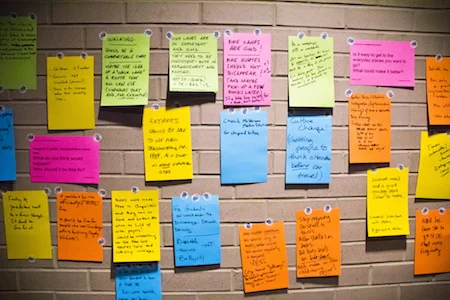
In accepting a PM position with an organization that had no central place to capture and prioritize product-related requests generated from each department, I decided to pull together the lists from all the stakeholders into a common forum.
The Product Decision: Use Trello to pull together the wish lists from all the stakeholders into a common forum.
In accepting a PM position with an organization that had no central place to capture and prioritize product-related requests generated from each department, I decided to pull together the lists from all the stakeholders into a common forum.
Of course departmental wish lists had been created over the years but were languishing as disparate spreadsheets, as bulleted lists in shared Google docs and as giant backlogs in our issue tracking software. These lists had not been kept current, were not being shared, and thus were impossible to synthesize for product planning.
What drove this decision
So what I really inherited was a bigger challenge and this was a known problem throughout the company. The lack of a central place to discuss product priorities had led to more than a few skirmishes and past product releases had been poorly received as various constituencies inevitably had begun to feel neglected or and complained that the Product Team simply misunderstood their needs.
I am now in charge of the Product Roadmap. As any Product Manager knows, this is a challenging assignment as it involves collecting, verifying, and prioritizing inputs from many stakeholders. To get started, I wanted to review any previous roadmaps and revisit the current backlog of requests from Sales, Customer Support, Operations, etc. The old roadmap was easy to locate but when I started asking around for the backlog, I was surprised to learn that there wasn’t one.
The decision: Introduce the team to Trello

I needed to (re-)create a forum where each department could list their own issues and make them visible to the other groups. It had to be conducive for collaboration and ultimately, allow stakeholders to collectively agree on the next set of priorities. But most of all, it had to be easy to use.
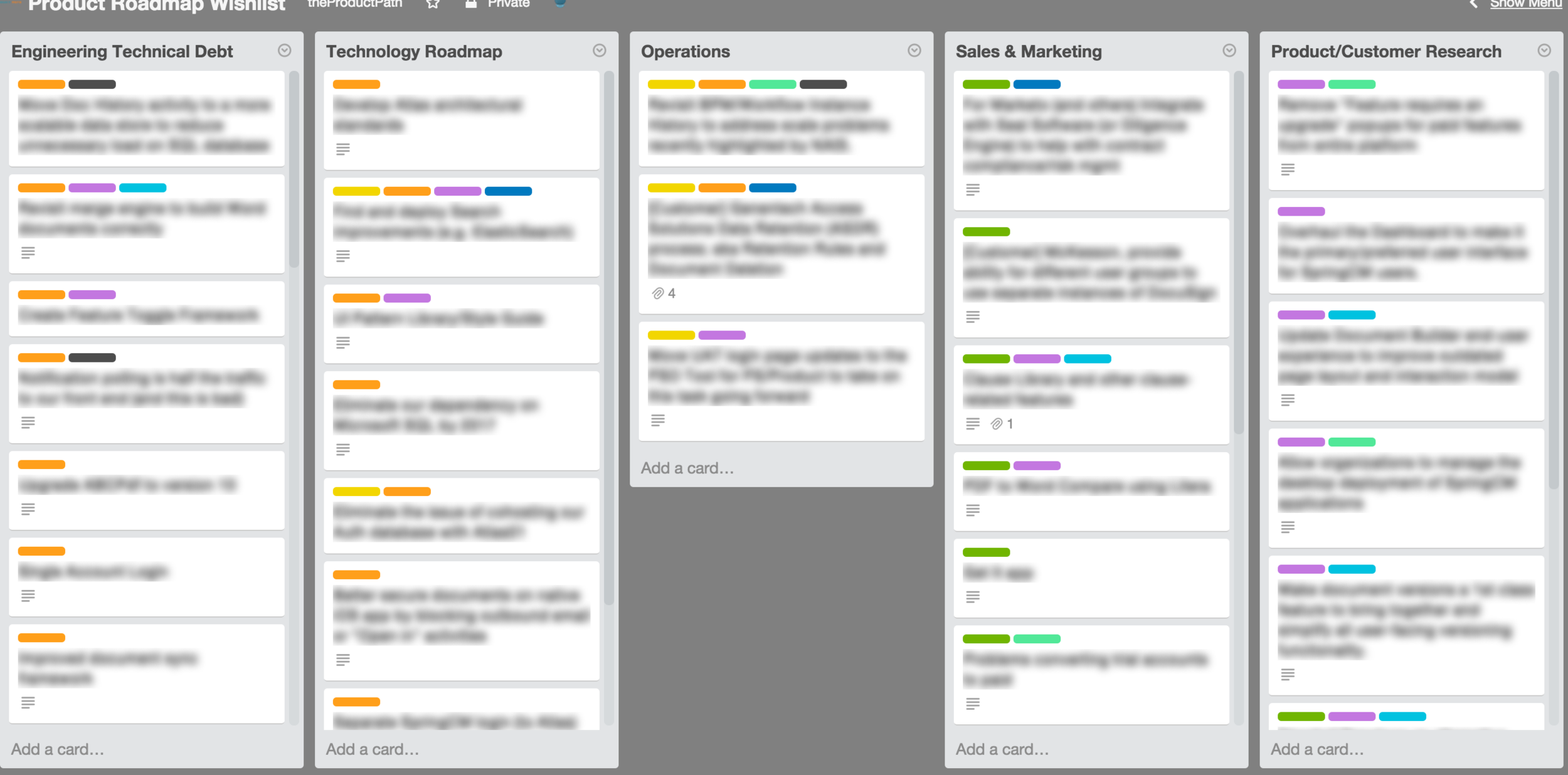
I decided we would begin planning high level product strategy using a shared Trello board. Trello is a flexible online tool that helps you organize lists and is very simple to use.
- The free version would more than suffice for the size of our team and our limited needs
- Those who chose to invest more energy in capturing their requests would have ample means to do so using Description fields and other Trello features
- Each card would have its own comment thread to encourage and preserve group discussions
- Users have the option to use card-level voting to avoid duplication and find common ground
- Plus, the good folks at Trello have made it work equally well in browsers, on tablets and on mobile phones
Plan of attack
I cannot share our company's product priorities here of course but you may adapt this approach for your company's own planning needs.
Build new board with a good name
I started by creating a new Trello board for our company and named it “Roadmap Priorities”. I chose the name intentionally as I knew I would need to push back on well-meaning folks who would get carried away creating cards that were important to them and the company, but ultimately unrelated to our product strategy. Instead, I encouraged them to create separate Trello boards for their own departments.
Create a list for the current release
To provide some perspective to the group, I created the first list on the board and backfilled it with cards that represented our current set of priorities, mostly to provide a model for what we would be aiming for in future strategy sessions. I made this the left-most list on the board so they would see it first and that proved helpful in on-boarding users who were new to Trello.
Prime the board with existing lists and examples
I created separate lists for each Department so that each would have a place to add their own set of cards. In an effort to prime the pump, I imported a few lists from existing spreadsheets that had been floating around some of the departments. For other groups, I created some sample cards to give them a starting point. In this way, I was able to accelerate the adoption of Trello and the roadmap planning discussions.
Use colored labels for Each department
I used Trello’s colored Labels to assign a unique color to each department. This has made it easier to identify the originating department for each request and, as we move over cards to create a single “Release” list, has allowed us to see the relative priorities of each department. Even better, by combining multiple departmental labels on a single card, we were able to quickly find common ground among common requests.
Invite collaborators to the board
I formally invited all the department heads to join the board. For some teams, it made sense to invite more than one person, especially where I anticipated some early, tool-related friction. Each collaborator received a friendly email invitation with a simple call to action to join the Trello board.
Onboard stakeholders
Even though Trello makes the sign-up process easy for new users, I expected and struggled with early engagement. As a precaution, I also schedule 15-minute meetings with each stakeholder to get them past the initial access challenge (e.g. logging in) and to provide a quick tour of Trello. The preparation (described above) went a long way to getting early buy-in. Stakeholders immediately identified with their department and were comforted to see familiar items in their own lists.
In explaining to the stakeholders how I would be using the board and the cards on each list, I also tried to motivate them by strongly implying that the best prepared departments would have a chance of seeing their priorities folded in to our roadmap.
The impact
The results for our company have been quite promising in these early weeks. Five of the six departments have been very active on our Roadmap Priorities board and that is making the planning for our next release much easier for the Product team. Trello deserves a great deal of the credit for providing such an amazing tool and we have witnessed its broader adoption throughout the company.
Look for more reports from theProductPath around Trello, roadmap planning, and working with stakeholders here on PM Decisions.
More articles from our blog PM Decisions


In a dauntless attempt to answer the near ubiquitous question, "What does a Product Manager do?", I decided to dedicate an entire year to recording and sharing my own journey down the product path.
The Product Decision: Contribute to the growing body of knowledge by sharing weekly accounts of my on-the-job product experiences as the Head of Product for a late stage startup.