Convey the Product Vision to outside influencers
To do my part in helping promote the company with external stakeholders, I decided to tune up my product presentation to deliver a compelling blueprint for the future.
The Product Decision: Prepare and pitch a more strategic product roadmap that could accommodate a broader range of business conversations.
To do my part in helping promote the company with external stakeholders, I decided to tune up my product presentation to deliver a compelling blueprint for the future.
An early stage company often needs to do more than simply sell and support its products. For instance, there are occasions where larger and longer term plans must be discussed to advance the business through the help of customers, partners, and investors.
As the Head of Products, I often participate in these discussions, usually to tell our unique story from a product perspective. My contribution is relating all the progress made over the past weeks and months to the broader and still unfolding product narrative that will continue to propel us forward in the years ahead.
What drove this decision
With all the hyperbole about taking it to the next level, I rarely see anyone writing about what you do when you get there. There is, of course, the want to celebrate the achievement but that is short-lived and you usually don't rest there for very long. The same energy and passion and drive that got you and the team to this point is what will ultimately compel you to keep moving forward.
My company had reached another stage in its growth and it was time to turn our sights to the next plateau. New players were now starting to take an interest in the company and it would take additional time and energy investments on our part to engage with them.
It should be no surprise then, that in this situation, I would turn to the same tools and tactics I had used to help get our company this far. It was clear to me that, going forward, I would be telling and selling an even larger product vision.
The decision: Prepare and pitch a more strategic product roadmap that could accommodate a broader range of business conversations.
The product roadmap continues to be my go-to asset for constructing full and lively reports, especially with those unfamiliar with our business. I continuously tweak our roadmap, not just to reflect the evolving initiatives and priorities but also to help me tell better stories.
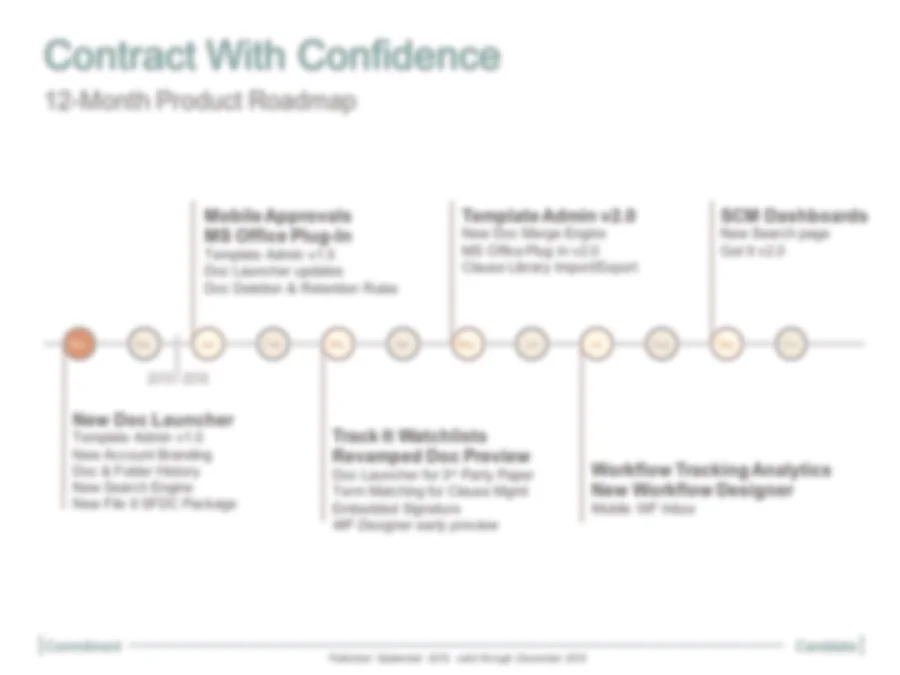
Every so often, I am able to produce a rendition of the roadmap that has just the right amount of fidelity. When that happens, I can communicate equally well with everyone from Engineers to Board members. This was one of those occasions where details about individual features or shorter-term enhancements would be folded into larger themes that stretch out for many months and clearly connect parallel product initiatives.
Plan of attack
Over the past year, I had been more tactical with my product plans, mostly with the intent of rebuilding credibility with the other departments in the organization. Now, I was focused on communicating our product direction to audiences outside the company.
Highlight product advancements to strategic partner
My first opportunity came in an early stage discussion with a new partner. This group was more familiar with the general domain, our specific problem space as well as our closest competitors. So there was no need for me to start all the way back at square one. They would understand how the pieces of our platform fit together, where our ongoing innovation was helping us take a leading position in the market, and how we were preparing to address weak spots in the product.
In covering the roadmap, I stepped through a number of the major past and future milestones to highlight where this partner could "plug in" and expand the value for our joint customers. This tailored view of our company's go-forward product plans ultimately helped them construct a companion roadmap for a strong joint offering.
I found this conversation to be very productive as little time was wasted covering small details. Instead, we were able to focus on a series of touchpoints around which a mutual partnership could be developed.
Communicate rate of progress to potential investors
anytime I find myself in front of investors, I try to emphasize the current product returns realized from past investments.
My next challenge was to use the same roadmap material to build a story that communicated how recent product advancements had directly contributed to the best year in the company's financial history.
The first part of that story was tying important customer victories to key product milestones in an attempt to prove some level of correlation. Indeed, we had prioritized some of our work over the past year to help advance large deals in the sales pipeline.
More than that perhaps, I wanted to communicate that we felt we had nailed the product-market fit and that customers were more regularly landing directly in our sweet spot.
And anytime I find myself in front of investors, I try to emphasize the current product returns realized from past investments. This audience, more than any other, responds well to proof around ROI.
Demonstrate domain expertise and solid product planning to an unacquainted party
The last test was to engage a new group that had no prior contact with our company and no exposure to our particular problem space. For this discussion, I chose to deliver an expedited product overview that highlighted achievements from the past year. My goal was to try to condense the past 12 months and past 5-10 years into a 45-minute presentation - without losing my audience.
Because I didn't know how long I would be able to hold their attention, I decided to focus on how good we had been (and would continue to be) at product planning. I wanted to show how well we understood our customers' problems and why we were confident that we hold our place as a leader in the market.
I was able to underscore this by calling attention to a few parallel development threads in the roadmap that had recently converged to deliver big payoffs for our customers.
The impact
I received positive feedback from participants in all three meetings over this week. Ultimately, I believe the outcomes were largely driven by the preparation time spent on the roadmap material itself. I have been able to get a great deal of mileage from my product roadmap by making sure that it clearly communicates product intentions, that it justifies product investments, and that it ties these investments back to actual customer needs.
Look for more reports from theProductPath around socializing roadmaps, product roadmap themes, and managing stakeholders here on PM Decisions.
More articles from our blog PM Decisions
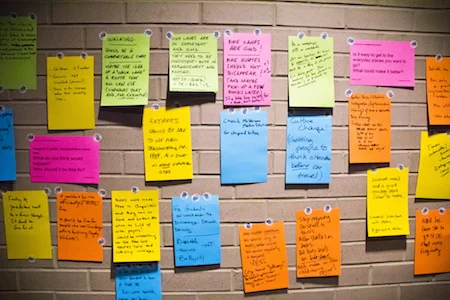

Repave the road...map
After inheriting a weathered product roadmap whose years of wear and tear had been the source of chronic problems for our company, I decided to fortify its very foundation.
The Product Decision: Repair the roadmap infrastructure.

Image source: https://www.flickr.com/photos/willemvanbergen/4498186500
After inheriting a weathered product roadmap whose years of wear and tear had been the source of chronic problems for our company, I decided to fortify its very foundation.
Like many early stage companies, we had been struggling with product direction, with making and keeping promises to customers, and with overall Engineering churn. The source of many of these problems was a Product Roadmap that frequently over committed and that failed to adhere to any consistent vision.
What drove this decision
It's fair to say that no one expects every promise to come true. And that holds for product roadmaps as well. Roadmaps are simply a plan that drives towards some future state of your product and as Eisenhower famously said, "Plans are nothing, planning is everything".
Some Product Managers get into trouble when they get too specific about future plans and end up prematurely commit to features and dates in their roadmaps. This was a perpetual problem at my company and over the years, our credibility with customers and prospects as well as with internal sales & support teams had deteriorated.
The change in leadership on the Product team presented me with an opportunity to address the problem head on but that would require some real road(map) construction work.
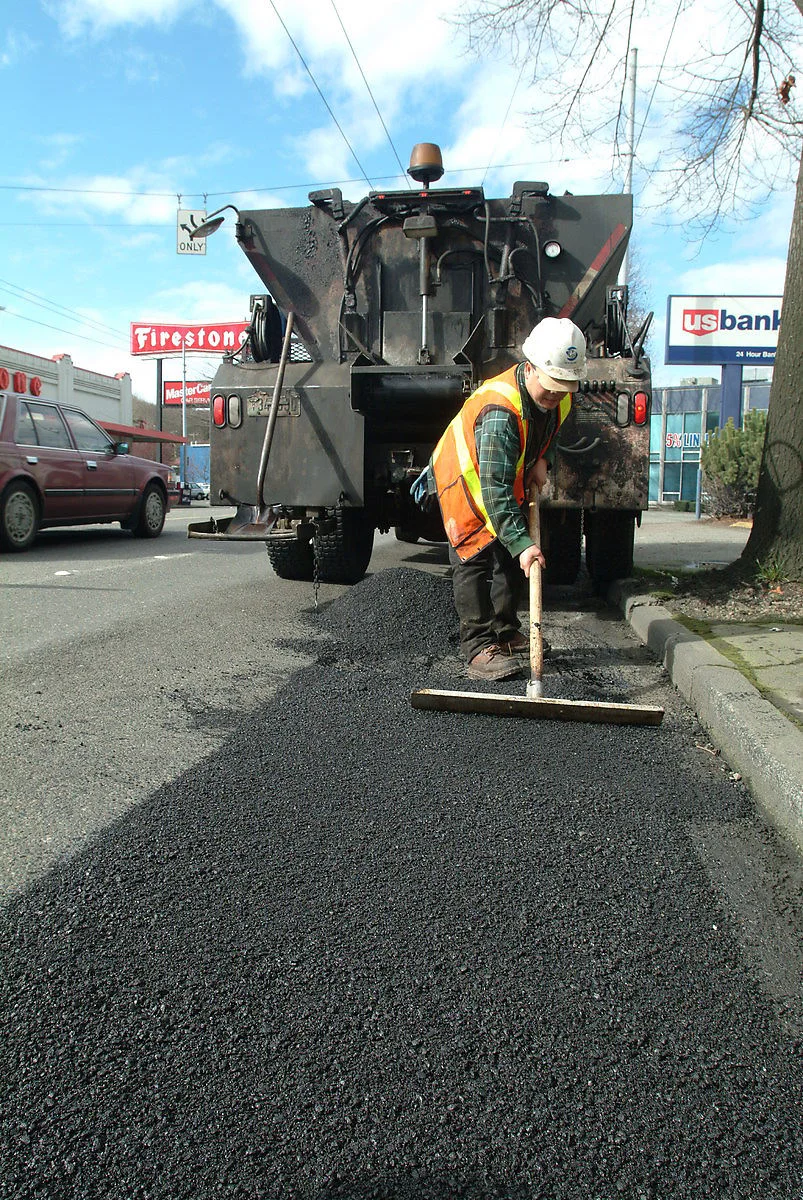
Image source: https://www.flickr.com/photos/seattlemunicipalarchives/3749710569
The decision: Repair the roadmap infrastructure
There are quite a few good sources on the Internet that describe proven techniques for constructing sound product roadmaps and bolstering product planning efforts. Indeed, the tactics described here are not fundamentally revolutionary. What is novel perhaps, is how, with a few straightforward changes to how we built and socialized our product roadmap, we were able to directly address and ultimately improve the Product team's credibility.
Plan of attack
We identified and committed to three changes (at least in this first phase of construction) that would yield the most value for our stakeholders. They are not mutually dependent and could be done in any order.
Use 3/6/12 months increments
We immediately dropped the former convention of spelling out exact release dates in the roadmap. Instead of prematurely committing to specific monthly releases, for example, we create a 3/6/12 month plan. Because our confidence was much higher in the short term feature enhancements, we described these in more detail on the roadmap. And we decreased the level of detail around features as we moved into the six- and 12-month phases.
This change shifted the focus away from specific dates and to the prioritization and staging of the work itself.
“We use high-level themes because it makes communication simpler and allows us to keep uncertain details vague. It also helps to limit scope creep – if a request for a new feature doesn’t align with the agreed themes then it’s easy to push back. The use of themes, combined with broad delivery windows as we move into the future, helps us to be more confident that we can deliver what’s on the roadmap.”
Create themes for prioritizing product decisions
Roadmaps that stretch out for months or years can be complicated and unwieldy for the newcomer. It is difficult to capture all the finer points of a Roadmap in a high-level, visual chart or to communicate all the thinking that went into developing it.
To make our Roadmap easier for others outside the Product team to consume, we introduced and described a few themes. These themes helped to visually connect different units of work so that the causal observer could find order in the abundance of features.
The themes helped our audience to better understand our decision process. For instance, we could show how when a particular feature on the roadmap aligned with multiple themes it was given higher priority over other features.
Separate commitments from candidates
There is another simple technique that roadmappers can employ to avoid making explicit promises, especially when facing increased uncertainty about the ability to deliver features far down the road.
On any/all external facing versions of your roadmap, you include a graph that has two opposite endpoints: Commitments and Candidates. The features about which you feel more confident, likely the ones you will tackle sooner, will appear on the Commitment end of the graph. The features that are further out in the future will inevitably be designated as Candidates on the graph.
While this tactic might seem obvious to you and your Product team, it will help to set the proper expectations with your stakeholders and help you stave off unproductive conversations around future roadmap commitments.
The impact
I published the updated Product Roadmap at the beginning of the year with these three improvements: 3/6/12 month timelines, high-level themes, and a commitment/candidate graph. And, while the changes were relatively simple, the outcome was significant. Product conversations with internal and external audiences were more focused. Our team spent less time explaining or defending our decisions and more time engaging stakeholders in productive dialogue about solving important customer challenges.
Look for more reports from theProductPath around product roadmaps, roadmap planning, and managing stakeholders here on PM Decisions.
More articles from our blog PM Decisions

In recognizing that we were finally in a position to start gathering real requirements from a prime new customer, I decided to move forward with building a prototype for a new product offering.
The Product Decision: Complete a working prototype that we could use to drive productive conversations with customers around requirements.