Convey the Product Vision to outside influencers
To do my part in helping promote the company with external stakeholders, I decided to tune up my product presentation to deliver a compelling blueprint for the future.
The Product Decision: Prepare and pitch a more strategic product roadmap that could accommodate a broader range of business conversations.
To do my part in helping promote the company with external stakeholders, I decided to tune up my product presentation to deliver a compelling blueprint for the future.
An early stage company often needs to do more than simply sell and support its products. For instance, there are occasions where larger and longer term plans must be discussed to advance the business through the help of customers, partners, and investors.
As the Head of Products, I often participate in these discussions, usually to tell our unique story from a product perspective. My contribution is relating all the progress made over the past weeks and months to the broader and still unfolding product narrative that will continue to propel us forward in the years ahead.
What drove this decision
With all the hyperbole about taking it to the next level, I rarely see anyone writing about what you do when you get there. There is, of course, the want to celebrate the achievement but that is short-lived and you usually don't rest there for very long. The same energy and passion and drive that got you and the team to this point is what will ultimately compel you to keep moving forward.
My company had reached another stage in its growth and it was time to turn our sights to the next plateau. New players were now starting to take an interest in the company and it would take additional time and energy investments on our part to engage with them.
It should be no surprise then, that in this situation, I would turn to the same tools and tactics I had used to help get our company this far. It was clear to me that, going forward, I would be telling and selling an even larger product vision.
The decision: Prepare and pitch a more strategic product roadmap that could accommodate a broader range of business conversations.
The product roadmap continues to be my go-to asset for constructing full and lively reports, especially with those unfamiliar with our business. I continuously tweak our roadmap, not just to reflect the evolving initiatives and priorities but also to help me tell better stories.
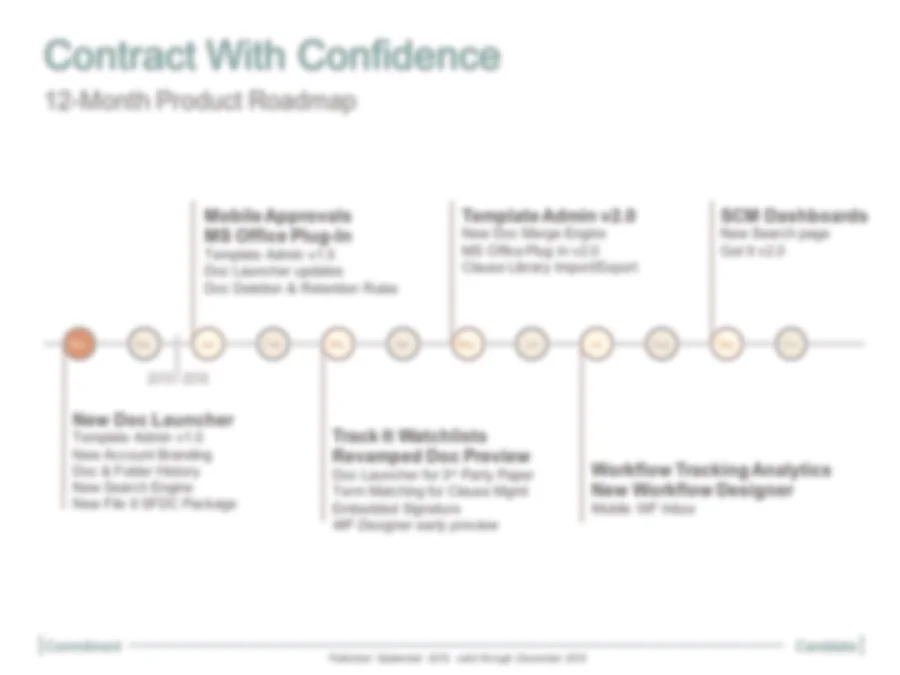
Every so often, I am able to produce a rendition of the roadmap that has just the right amount of fidelity. When that happens, I can communicate equally well with everyone from Engineers to Board members. This was one of those occasions where details about individual features or shorter-term enhancements would be folded into larger themes that stretch out for many months and clearly connect parallel product initiatives.
Plan of attack
Over the past year, I had been more tactical with my product plans, mostly with the intent of rebuilding credibility with the other departments in the organization. Now, I was focused on communicating our product direction to audiences outside the company.
Highlight product advancements to strategic partner
My first opportunity came in an early stage discussion with a new partner. This group was more familiar with the general domain, our specific problem space as well as our closest competitors. So there was no need for me to start all the way back at square one. They would understand how the pieces of our platform fit together, where our ongoing innovation was helping us take a leading position in the market, and how we were preparing to address weak spots in the product.
In covering the roadmap, I stepped through a number of the major past and future milestones to highlight where this partner could "plug in" and expand the value for our joint customers. This tailored view of our company's go-forward product plans ultimately helped them construct a companion roadmap for a strong joint offering.
I found this conversation to be very productive as little time was wasted covering small details. Instead, we were able to focus on a series of touchpoints around which a mutual partnership could be developed.
Communicate rate of progress to potential investors
anytime I find myself in front of investors, I try to emphasize the current product returns realized from past investments.
My next challenge was to use the same roadmap material to build a story that communicated how recent product advancements had directly contributed to the best year in the company's financial history.
The first part of that story was tying important customer victories to key product milestones in an attempt to prove some level of correlation. Indeed, we had prioritized some of our work over the past year to help advance large deals in the sales pipeline.
More than that perhaps, I wanted to communicate that we felt we had nailed the product-market fit and that customers were more regularly landing directly in our sweet spot.
And anytime I find myself in front of investors, I try to emphasize the current product returns realized from past investments. This audience, more than any other, responds well to proof around ROI.
Demonstrate domain expertise and solid product planning to an unacquainted party
The last test was to engage a new group that had no prior contact with our company and no exposure to our particular problem space. For this discussion, I chose to deliver an expedited product overview that highlighted achievements from the past year. My goal was to try to condense the past 12 months and past 5-10 years into a 45-minute presentation - without losing my audience.
Because I didn't know how long I would be able to hold their attention, I decided to focus on how good we had been (and would continue to be) at product planning. I wanted to show how well we understood our customers' problems and why we were confident that we hold our place as a leader in the market.
I was able to underscore this by calling attention to a few parallel development threads in the roadmap that had recently converged to deliver big payoffs for our customers.
The impact
I received positive feedback from participants in all three meetings over this week. Ultimately, I believe the outcomes were largely driven by the preparation time spent on the roadmap material itself. I have been able to get a great deal of mileage from my product roadmap by making sure that it clearly communicates product intentions, that it justifies product investments, and that it ties these investments back to actual customer needs.
Look for more reports from theProductPath around socializing roadmaps, product roadmap themes, and managing stakeholders here on PM Decisions.
More articles from our blog PM Decisions

Fire up the Sales team
After being invited to participate in our mid-year, internal Sales team rally, I decided to deliver a rousing product presentation to get the troops pumped up.
The Product Decision: Weave together a powerful before/after story that relates the numerous product enhancements as well as our impressive rate of innovation to stir the team and inspire them to carry that message to our customers.

Image source: https://www.flickr.com/photos/spacelion/3008520385
After being invited to participate in our mid-year, internal Sales team rally, I decided to deliver a rousing product presentation to get the troops pumped up.
Over the course of my career, I have spent months embedded with various Sales teams and I would recommend it for any aspiring Product Manager looking to better understand their stakeholders. Some of their customs, however, may still be a bit peculiar, at least to me. In particular, there is this practice of routinely gathering the entire Sales team for an entire day or two, typically somewhere away from the office with the intent of re-energizing everyone.
I know that the Sales team, like most other teams, have their own set of priorities and that they don't often stay as connected to the products as I would prefer. So I find it valuable to take advantage of occasions like this to better "align" myself and our products with the Sales team.
What drove this decision
We had recently hired some new folks into the Sales ranks over the past few months and the entire team had been focused on rolling out an updated sales process with our revamped Marketing team. This meant less bandwidth for absorbing the last few rounds of product updates.
Everyone in the company is invited to attend our monthly Release Previews of course but Sales attendance, in particular had been somewhat spotty for awhile.
Now, with this mostly captive audience, I had a chance to focus everyone's attention on our Products and to remind the team how much progress we have made in the last six months.
The decision: Weave together a powerful before/after story that relates the numerous product enhancements as well as our impressive rate of innovation to stir the team and inspire them to carry that message to our customers.
I can't blame our Sales reps for settling into a comfortable routine and sticking with a story that works for them. Asking them to change up their narrative every time we release new software is a little unrealistic. But I knew that the product improvements we had made over the past six months had been significant and would have a big positive impact on the way we all were engaging with our customers.
Our company had indeed devoted a great deal of time to understanding our customers' pain and I knew we could speak to that confidently. But I had sat in on enough product demos to know that there were plenty of rough spots - areas of the product that didn't show particularly well. Much of the Product effort in the first half of the year went to address these specific issues and our story needed to be refreshed to incorporate every one of those Product improvements.
Plan of attack
They gave me 60 minutes to dazzle the troops.
They gave me 60 minutes to dazzle the troops. Even the best slides would not likely keep their collective attention for that long so I supplemented a PowerPoint presentation with live product demos and tantalizing prototypes to help keep them captivated.
The goal for me was to have everyone walk away with renewed pride in our company's product and more importantly, for each of them to feel even more confident that we were truly the best option for solving our customers' problems.
Create a backdrop for the main narrative
The first step was to set up a familiar context around which I could piece together the different elements of the story. As a framework for my slides, I decided to use a 1-page diagram I had created months earlier as a sales aid to help orient our prospects and drive productive sales discussions. I began by highlighting a number of improvements I had made in this iteration of the diagram to help me grab the team's attention at the very start.
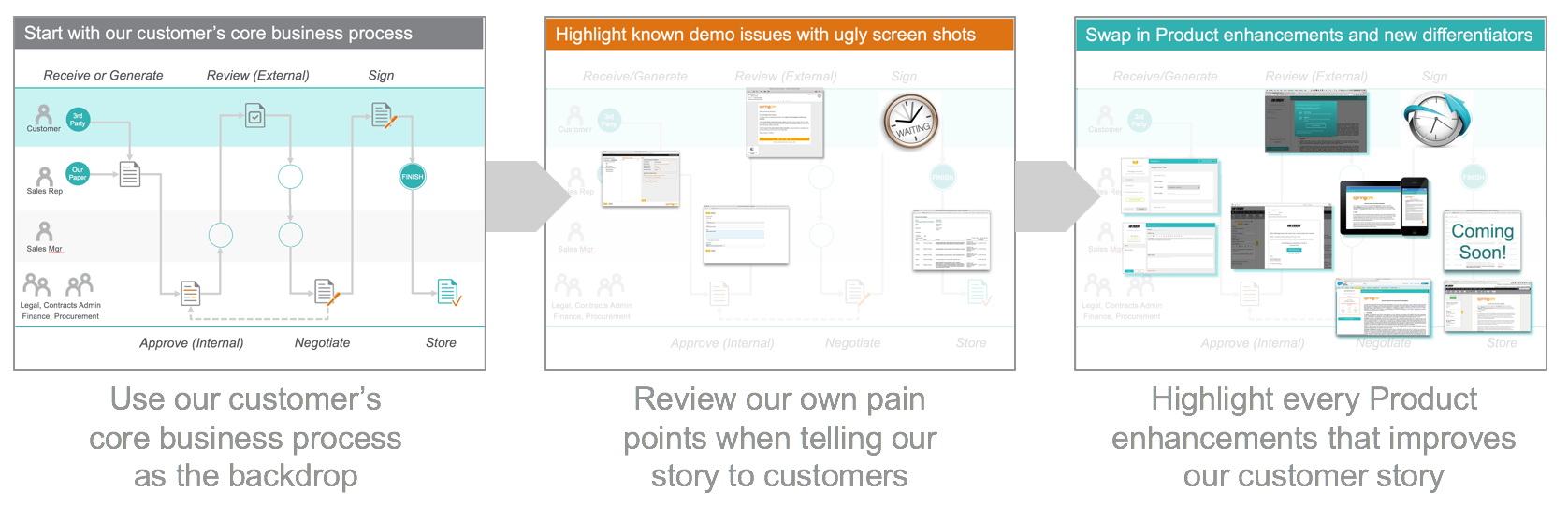
My (abbreviated) presentation flow for the Sales team tells a before/after story using the familiar customer process as the backdrop
Show old screenshots highlighting the known bad spots
The next step was easy. I found old screenshots from the recent past and positioned them on top of the diagram. This had the intended effect of reminding everyone how hard it once was to brag about our solution. During the presentation, I intentionally exaggerated the struggles associated with this familiar but outdated description of our product - but concluded that this awesome team was still able to sell that version. The good news is that it wouldn't get any worse!
Replace with new screenshots
Then, one by one, I swapped in the new hotness. Gradually, I unfolded our updated story to the group showing how all our pain points had been (or would soon be) addressed. Even better, the Product team had introduced entirely new features that helped to strengthen our overall story. The resulting picture not only improved on the known problems but gave the Sales team even more talking points and would help them address customer issues that we might have dodged in the past.
Tease with early prototypes
But wait - there's more! Stacking up all the existing enhancements on a single slide was certainly effective but to really energize the crowd, I then switched gears and started demoing some of the new stuff that was just around the corner.
Using live code that was still working its way through QA along with fancy, clickable prototypes created by our UX team, I began to weave an even stronger narrative for our Sales team to use immediately with their prospects and customers.
The impact
My talk had the intended effect and I was certainly encouraged by all the positive feedback from the team. I do realize that the real payoff for the company will only come when they carry this updated story to the front lines.
I remember days in recent past where Sales Engineers would brush past certain areas of the product or skip them entirely hoping that the prospect wouldn't notice. I also remember the collective cringe when a savvy customer would ask to explore the next level of detail behind a particularly well-manicured product demonstration.
With this presentation, I made it clear that we would no longer have to avoid those areas of our product. Instead, I urged our team to intentionally stop and even linger at certain points in the demo to prompt more productive conversations. I wanted our customers to ask those tough questions and engage further with us. We had even more reasons to be proud of our company's products and what's more, could now point to an impressive rate of product improvement over the past six months.
Look for more reports from theProductPath around product review, product culture, and socializing product roadmaps here on PM Decisions.
More articles from our blog PM Decisions


Recalibrate product priorities for the next 6 months
As we approached the half-year mark, I recognized that I needed to regroup with my internal stakeholders to make adjustments around what we would be delivering for the second half of the year.
The Product Decision: Organize and facilitate a product strategy summit with all the department leaders to revisit and rebalance priorities.
Flickr image source: http://tinyurl.com/pb94a5u
As we approached the half-year mark, I recognized that I needed to regroup with my internal stakeholders to make adjustments around what we would be delivering for the second half of the year.
You could argue that the half-way point through a calendar year is a somewhat arbitrary juncture, but nevertheless it provided me with a good checkpoint opportunity. Since the beginning of the year, my team had planned, built, tested and delivered product updates through several releases. Before we commenced with the next cycle, I wanted to revisit our priorities and review any significant changes in the business that would require some course correction in the product roadmap.
What drove this decision
I was confident that the Product team had been addressing the full range of demands and that we would continue to balance stakeholders' priorities as we were all committed to satisfying our end customers' needs.
We had already begun to carve out big plans for the next 6-9 months and some of them would require significant investment. I knew we were aligned with individual departments but over time, the various department heads had lost sight of what was most urgent for their peers. It would be more difficult for me to deliver and promote an updated product roadmap without some preliminary group consensus at the topmost level.
The decision: Organize and facilitate a product strategy summit with all the department leaders to revisit and rebalance priorities.
I will be the first to admit that the word "summit" sounds a bit lofty (pun intended) but I assure you this was not some trumped up, off site boondoggle - I'm saving that for my big end of year 1st Annual Product Strategy Retreat.
My goal was simply to get all the department VPs and some key Directors in the same room and run through a formal, Product-focused agenda. I wanted to use the time to review the roadmap choices we had made over the last 6 months (some good, some bad) and continue to push the company to pursue sound product investment decisions.
Balancing 3 related concerns: curb appeal, interior living space, and structural foundation
In the many discussions I had been having with the different departments leading up to this summit, it became increasingly clear that there was a lack of mutual appreciation, if not basic understanding of what was driving the other departments' priorities. A number of the stakeholders were out of touch.
I wanted to share this insight with the invitees but in a way that didn't offend or alienate a particular group. In the summit invite, I offered the following apartment building metaphor to help explain the different, but complementary perspectives of each group:
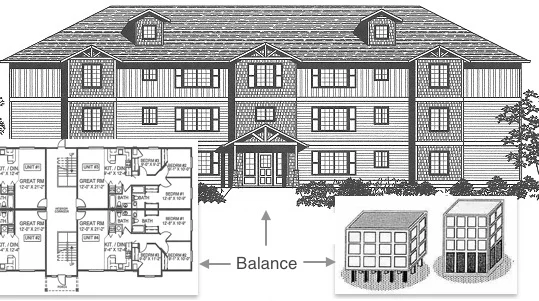
Image sources: http://tinyurl.com/nbzkcoz, http://tinyurl.com/pno7n9f
- Sales wants the building to have massive curb appeal, to look good from the outside so as to increase the chances of attracting new customers.
- Customer Success wants all our new tenants to have a smooth move-in experience and to enjoy living in their new home for many years.
- Operations wants to make sure the building itself can safely support all the tenants and their various housing needs.
And of course everyone in the organization should be focused on increasing customer satisfaction as it will lead to renewals and referrals!
Plan of attack
Setting proper expectations: everybody wins! everyone loses!
I started the meeting by setting expectations for the group - which largely meant telling them that no one was going to get everything they wanted. The summit was an exercise rooted in compromise. I told them that it was equally important for them to defend their own priorities as it was to become more aware of what the other departments were struggling with.
The bulk of our time in the summit was spent prioritizing a lengthy list of wish list items. To kick things off, though, I offered an assessment of the past six months to remind everyone why we built the things we did and to get some feedback.
Review the roadmap themes for the year
I first presented the product strategy I had introduced at the beginning of the year that outlined how I would be making decisions for the next 12 months. Specifically, I highlighted the roadmap themes that were established back then and verified with the group that we were still confident in those decision-making guidelines.
Review 1st six months
Building on the initial validation from the group, I proceeded to show how the recent product decisions we had made were in line with the roadmap themes. This brief, high level review of the advancements we had made in our product portfolio over the past 6 months provided an ideal opportunity to explore queries such as:
- How accurate was the original plan and how close did we come to hitting our targets/metrics?
- Are the major initiatives still on track or have there been new insights that require us to adjust our course?
- What have we learned about estimating work, about dependencies, about our ability to accurately respond to customer demand?
I was certainly pleased to hear the group confirm that the first half of the year was largely productive and that we had been made solid product investment decisions.
First pass at prioritization
From the Trello board I created to capture individual wish lists for the different departments, I pulled the top 30-40 cards to start the prioritization exercise. The first step was to bucket the items into either one of only two lists: High Priority or Low Priority.
This first pass proved to be relatively easy for the group. I was pleased to see the Low Priority list ultimately accumulate many more cards which meant the final pass would be that much easier.
Overall, it was a constructive discussion. None of the participants were particularly unreasonable and did not fight excessively for their own items. I did occasionally use the following prompt when we seemed to be getting stuck: "Can we get through the second half of the year without spending any time on this item?" That was often the only nudging that was required to properly bucket the topic.
Crash course on product constraints
I had prepared a break in the summit schedule in case we needed a cooling off period - and intentionally scheduled the catered lunch to arrive during the break. It turned out there hadn't been that much contention so I instead used the break to revisit some of our constraints and to remind the group about why the next half of the exercise was going to be frustrating for all. Specifically, I talked briefly about the following topics:
- Our true development capacity - what we should really expect from the current size and skill level of our Engineering teams. Read more about setting expectations around Engineering capacity here.
- Software's total cost of ownership - how each line of code we add requires more of our company's resources from Product, Engineering and QA all the way through documentation, support, and training.
- Opportunity costs - each time we agree to start building something new, we must recognize how that will limit our ability to respond to the next "must have" requirement (yeah Sales, I'm talking to you!)
I can't be sure if all the messages landed on point with the entire group but it was my meeting and I was going to take advantage of this ideal product soapbox opportunity.
Final pass at prioritization
In the home stretch, the group now turned its attention to reviewing the much shorter High Priority list (14 items, down from 40). One by one, I went around the table to get individual input. I guided the group by having each of them select 1 primary item and 1-2 backup items.
When we had finished the final pass, we had arrived at a prioritization list that had mutual support from all departments. And I had a clear indication of how I would be adjusting the Product Roadmap for the second half of the year.
The impact
Not only did we finish the full exercise (on time no less) with a shared prioritization list but I was told afterwards by the group members that it was one of the more amicable and productive meetings around product direction in which they had participated in recent memory.
I made it clear to the group that the summit was not designed to immediately produce a new or updated roadmap. It would take me more time to work through the items on the High Priority list and factor everything into the Product Roadmap for the second half of the year. Still, I would like to believe the outcome of the summit extended beyond achieving consensus around particular product priorities. I think it represented a milestone for advancing inter-departmental agreement. Maybe next time, I'll refer to it as a Product Peace Accord.
Look for more reports from theProductPath around feature prioritization, product strategy, and managing stakeholders here on PM Decisions.
More articles from our blog PM Decisions

In recognizing that we were finally in a position to start gathering real requirements from a prime new customer, I decided to move forward with building a prototype for a new product offering.
The Product Decision: Complete a working prototype that we could use to drive productive conversations with customers around requirements.